
Three things to know
- PD differs from home hemodialysis.
- Training and infection prevention are central.
- Manual exchanges and machine-assisted treatment are different approaches.
| Compare | Manual PD (CAPD) | Automated PD (APD) |
|---|---|---|
| Method | Exchanges performed by hand | Cycler moves fluid |
| Usual timing | Planned exchanges during the day | Often overnight; daytime treatment may also be prescribed |
| Equipment | Bags, tubing and catheter | Cycler plus bags, tubing and catheter |
| Both require | Training, infection prevention and follow-up | Training, infection prevention and follow-up |
How PD works
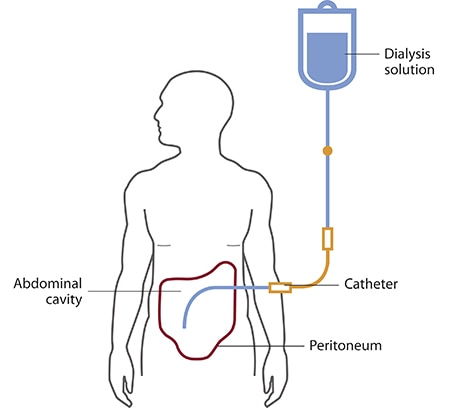
Dialysis fluid enters the abdomen through a catheter, stays for a prescribed period and then drains. Waste and extra fluid move into the solution. Your program prescribes fluid type, volume, timing and the number of exchanges; these should not be changed independently.
Manual exchanges or a cycler
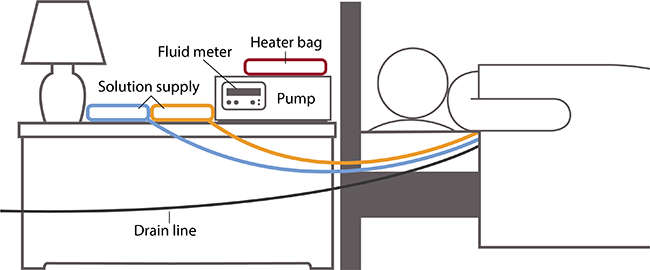
Continuous ambulatory peritoneal dialysis involves manual exchanges during the day. Automated peritoneal dialysis uses a cycler, often overnight. Some prescriptions combine approaches. Your medical needs and daily routine help determine what is suitable.
The PD cycle, simplified
What home preparation involves
The program teaches connection technique, catheter care, recording treatments and when to call. You need an appropriate treatment area and storage for supplies. Discuss pets, travel, work, vision, hand strength and caregiver needs openly so the team can assess practical support.
Recognizing problems early
PD can cause infection inside the abdomen, called peritonitis, as well as catheter-site problems. Cloudy drained fluid, abdominal pain or fever needs immediate contact with the PD team. Do not wait for a routine appointment or rely on a website to decide whether an infection is present.
Questions to bring to your visit
- Would manual exchanges or a cycler suit me?
- What space and training are needed?
- What is the plan for cloudy fluid?
Common questions
Is peritoneal dialysis the same as home hemodialysis?
No. Peritoneal dialysis uses the lining inside your abdomen and a catheter in your belly. Home hemodialysis uses a blood-filtering machine and access to your bloodstream. Both require a dialysis program, training and ongoing monitoring. Medical suitability, daily routine and available support help determine which option fits.
Can peritoneal dialysis be done while I sleep?
Automated peritoneal dialysis often uses a machine called a cycler overnight. Some prescriptions also include fluid remaining in the abdomen during the day or a daytime exchange. Your kidney team sets the schedule; overnight treatment does not necessarily mean that all daytime treatment tasks disappear.
What should I do if my drained dialysis fluid looks cloudy?
Contact your peritoneal-dialysis team immediately. Cloudy drained fluid can indicate peritonitis, an infection that needs prompt assessment, even if pain is mild or absent. Follow your program’s instructions rather than waiting for a routine appointment. Severe illness, confusion, fainting or trouble breathing requires emergency evaluation.
Do I need a family member to help with peritoneal dialysis?
Some people perform PD independently after training, while others need a trained helper. Your program assesses vision, hand strength, learning needs and available support. Ask who can help if you become ill, and what backup arrangements are available. Assistance services vary between programs and locations.
Can I work or travel while using peritoneal dialysis?
Work and travel may be possible with planning. Discuss treatment timing, a suitable space, supplies, equipment transport and access to help with your home program before making arrangements. Some jobs or activities need adjustments. Do not skip exchanges or switch treatment methods independently to fit a trip.
Does peritoneal dialysis mean I can stop my medicines or follow a normal diet?
No. Medicines, nutrition and fluid recommendations remain individualized. Dialysis may change your protein needs or how some medicines are used, but it does not replace all kidney functions. Review blood pressure, diabetes, appetite and laboratory results with your kidney team and renal dietitian before changing your routine.
Can I switch from peritoneal dialysis to hemodialysis later?
Sometimes. Infection, catheter problems, changes in health, treatment effectiveness or personal preferences can lead to reconsidering the method. Your team evaluates whether a switch is appropriate and arranges access and training when needed. Discuss concerns early so alternatives can be planned rather than decided during a crisis.
Does AspireMed provide the dialysis machine or deliver home treatments?
This guide explains options and helps you prepare for a kidney consultation. Equipment, hands-on training and dialysis treatments are arranged through an appropriate dialysis program. Ask about education and coordination during your consultation; a website request does not establish enrollment in a home-dialysis program.
Sources & further reading
Education supports, and does not replace, individual care. Dialysis treatments and transplant evaluations are delivered through the appropriate dialysis programs and transplant centers. External resources do not imply endorsement of AspireMed.