
Three things to know
- Home hemodialysis filters blood; PD uses the abdominal lining.
- Training and ongoing program support are required.
- Care-partner and home requirements vary.
| Feature | Hemodialysis | Peritoneal dialysis |
|---|---|---|
| Filtering method | Blood passes through an external dialyzer | Dialysis solution uses the abdominal lining |
| Access | Bloodstream access | Abdominal catheter |
| Setting | Center or a suitable home program | Usually home after training |
| Schedule | Prescribed by the dialysis team | Manual exchanges, a cycler or a combined plan |
| Shared needs | Training, monitoring and program support | Training, monitoring and program support |
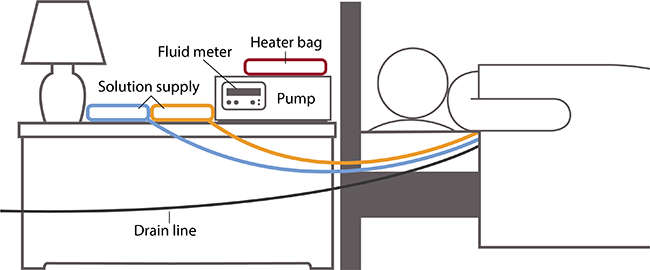
Comparing the methods
Home hemodialysis uses a dialysis machine and vascular access. PD uses an abdominal catheter and dialysis fluid, with manual exchanges or a cycler. Schedules, supply needs, access care and monitoring differ. Neither method is automatically best for every patient.
Assessing home readiness
The program may evaluate space, storage, electricity, water or plumbing requirements where relevant, and your ability to perform tasks safely. Vision, hand strength, learning needs, housing stability and support deserve a practical discussion. Do not assume your home is unsuitable without asking about available options.
Two home approaches
Training and ongoing help
Training includes equipment use, infection prevention, record keeping, alarm response and recognizing complications. Some home hemodialysis programs require a trained care partner; arrangements vary. Ask about clinic visits, laboratory checks, phone support and backup treatment.
Planning for real life
Discuss work, sleep, travel, caregiving and your comfort with treatment responsibilities. Ask what happens during a power outage, supply disruption or illness. Assisted home options depend on local program availability and should not be assumed. Your preference matters, but medical suitability and safe support remain essential.
Questions to bring to your visit
- Which local programs offer my options?
- Is a care partner required?
- What is the backup and emergency plan?
Common questions
Does home dialysis mean no clinic visits?
No. The program continues monitoring, laboratory testing and follow-up.
Will AspireMed provide home dialysis equipment or nursing?
These are arranged through the appropriate dialysis program. A consultation can support education and coordination without implying a home-treatment service.
Sources & further reading
- National Kidney Foundation: Home hemodialysis (opens in a new tab)
- NIDDK: Hemodialysis (opens in a new tab)
- NIDDK: Peritoneal dialysis (opens in a new tab)
Education supports, and does not replace, individual care. Dialysis treatments and transplant evaluations are delivered through the appropriate dialysis programs and transplant centers. External resources do not imply endorsement of AspireMed.